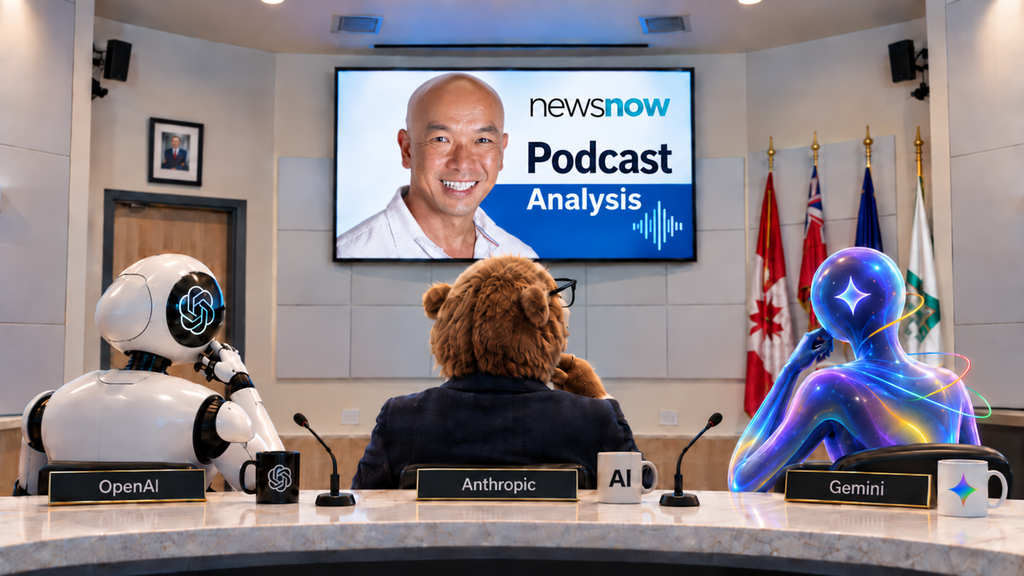
As the municipal campaign trail is now in full swing, we are starting to see the “podcast” emerge as a new venue for local Mayoral candidates to promote themselves and their platform. For Grimsby residents, this is happening through the NewsNow and Chamber of Commerce podcasts.
But not every person wants to sit through hours of watching all the podcasts, just to get the takeaways. As such, we have convened an “Engineered Multi-Model Review Panel” to do the analysis for you.
Skeptical of AI? Good. So are we.
That is why this was not a single prompt asking ChatGPT which candidate gave the best interview.
Three different AI models independently reviewed the complete NewsNow interview transcripts using the same evaluation framework. Each candidate was first assessed on what their own interview actually demonstrated, with untested areas left unscored. Where the models materially disagreed, those findings went through a separate peer-review process before the results were synthesized. Comparative scores were calculated only after those candidate-by-candidate assessments were completed.
The focus was not on which candidate a model preferred, but on the evidence: where a candidate showed command of an issue, where an answer broke down under questioning, where important information came from the interviewer rather than the candidate, and what subjects simply weren’t tested.
The goal isn’t to replace human judgment. It’s to apply the same consistent analytical process to each interview and show readers the evidence behind the conclusions.
So with that technical jargon aside, here is the Panel’s look at (in alphabetical order) the first of the three NewsNow participants, Simon Duong, and his interview with Mike Williscraft.
Source: NewsNow’s podcast interview with Simon Duong, conducted by Mike Williscraft. Quotations are taken from the published podcast.
AI REVIEW PANEL // ACTIVE
The Panel’s Read
Simon Duong presented his business, BIA, volunteer and community leadership experience as the foundation for why he believes he is ready to lead Grimsby.
His central argument was consistent: he knows how to bring people together, listen to different perspectives and move ideas toward results. The NewsNow interview demonstrated meaningful evidence for the first part of that case. Duong showed a genuine collaborative instinct and repeatedly emphasized that the Mayor is part of a collective Council rather than someone who simply dictates outcomes.
But when Williscraft moved from interpersonal leadership to how municipal government actually works, the evidence became substantially weaker.
The final Panel identified his clearest strengths as temperament, accessibility and consensus-building, while finding significant gaps in what he demonstrated about municipal authority, Town administration, the scale of municipal finances and decision-making at Niagara Region.
Candidate Snapshot
What Duong demonstrated: collaborative leadership, willingness to listen, recognition that the Mayor is one vote and realistic planning around the workload of the job.
Where the interview exposed weakness: the Council-Staff relationship, municipal procedure, Regional decision-making, municipal finances and turning ideas into workable plans.
What the interview did not establish: planning and housing, infrastructure asset management, Strong Mayor powers, broad economic-development policy, integrity and accountability and several other technical areas were not meaningfully covered.
Consensus-Building Was the Clearest Transferable Strength
Duong was most specific when discussing how he would work with Councillors:
“My style as a leader was always to talk to a person saying, hey, what’s your goal here?”
He explained that some people may not have the “polish” to communicate their ideas well and that he would try to understand what they were actually attempting to accomplish.
Later, he emphasized:
“It’s not just what my say goes. Because I’m just one vote as well.”
The final Panel treated that one-on-one consensus model as meaningful evidence of leadership ability. This is where Duong’s outside experience translated most clearly into something directly relevant to being Mayor.
He demonstrated an understanding that Council members have different objectives and communication styles and that the Mayor has to persuade and coordinate rather than simply command.
The problem was that the same strength did not carry through when the interview moved to the rules and structures that a Mayor has to work within.
Council-Staff Governance: NewsNow Supplied the Missing Distinction
Asked about Town administration, Duong said:
“I feel we need to get back to basics where, we run it kind of like a business.”
He then said:
“If a Councillor wants to approach a staff, they should go to the department head.”
Williscraft immediately corrected the structure:
“It’s not even that. They go to the CAO.”
Duong subsequently shifted toward the concern that Staff should not have “multiple bosses” and should be empowered to do their jobs. This later principle was reasonable.
But the administrative structure itself did not originate with Duong.
The final Panel found his understanding of the administrative structure underdeveloped and saw this exchange as evidence of a significant gap in his understanding of the Council-Staff relationship.
Strong people skills do not substitute for understanding the boundary between elected Council and Town administration, a core part of the Mayor’s role.
In this exchange, the interviewer had to supply the key distinction.
Council Procedure: An Informal Solution Without a Clear Municipal Process
Duong’s instinct for informal problem-solving also appeared in his proposed response to a Councillor attendance dispute.
He suggested taking the Councillor aside and saying:
“Why don’t you take a leave of absence without pay and go handle that and then come back to the Council?”
The instinct to speak privately before allowing conflict to escalate fits his broader consensus-building approach. But the proposed solution went beyond a private conversation and raised a question about what the Mayor actually has the authority to do.
The final Panel found that Duong did not make clear whether he was proposing a voluntary arrangement with a Councillor or suggesting that the Mayor could make the absence unpaid. The interview therefore did not establish how the Mayor could actually put that proposal into effect.
That distinction is important when judging how prepared someone is for the job.
Duong demonstrated how he would try to handle the person. He did not explain how that proposal would actually work under municipal rules.
Niagara Region: The Answer Did Not Survive the Follow-Up
Duong described Regional representation through teamwork. He said his role would be to gather information, return to the Town team and formulate Grimsby’s position.
Williscraft then raised the harder scenario: what happens when debate is underway at the Region and Grimsby’s representative must respond or vote without first returning to the team?
Duong answered by emphasizing preparation and homework.
Williscraft pressed again, specifically asking about the challenge of a learning curve at both the Town and Regional levels.
Duong’s response returned to his adaptability and business background.
The final Panel found that he did not fully answer the question of what happens when a decision has to be made at the Regional table before he can consult the Town team and instead returned to homework, teamwork and personal adaptability.
That is a case where the answer did not survive the follow-up. The question was no longer whether preparation is useful. It was whether Duong showed how he would make a decision when there was no time to return to the Town team first.
The interview did not establish that.
Municipal Finance: Ideas Without a Broader Financial Plan
Duong showed some fiscal realism when he said:
“I’m not going to campaign saying I’m going to reduce taxes… I don’t think it is ever going to happen”
He also argued that residents deserve clearer explanations of why taxes rise. That restraint deserves credit.
But his principal concrete financial proposals were a professional grant writer and sponsorship or naming opportunities. He acknowledged the limited scale of the latter himself:
“We’re not talking big dollars, but every little bit counts.”
The final Panel found that these ideas may have some value, but the interview did not demonstrate a broader financial plan dealing with reserves, debt, development charges or major spending choices.
A similar issue appeared when Duong described his strength as bringing ideas to fruition. Using wayfinding signs as an example, he said:
“That’s where my expertise comes in is to bring an idea to fruition.”
But the examples did not produce a clear plan for who would do the work, what it would cost, how long it would take or how success would be measured.
The final Panel therefore found that the ideas were clearer than the plan for carrying them out.
The recurring weakness was not a lack of ideas; it was showing how those ideas would actually work at the scale of a municipality.
The Five Grimsby Files
Taxes, Affordability & Fiscal Management
Duong declined to make an unrealistic tax-cut promise and emphasized better communication. His grant-writing and sponsorship proposals were supplementary ideas, but the interview did not demonstrate a broader municipal financial framework.
Growth, Development & Infrastructure Capacity
Duong discussed downtown water and sewer work mainly as a timing and communication issue. Williscraft supplied important Regional and grant context, and the interview did not meaningfully establish his knowledge of planning, servicing or long-term infrastructure management.
Niagara Region & Grimsby’s Representation
Duong emphasized preparation, information gathering and teamwork. Under follow-up, he did not demonstrate how he would handle live Regional decisions requiring an immediate position.
Council Leadership & Town Hall
His one-on-one consensus model was a genuine strength. His Council-Staff answer required Williscraft to supply the administrative distinction, while he did not explain how his attendance proposal would work under municipal rules.
Biodigester Litigation & Accountability
Duong did not meaningfully address the biodigester litigation. No position or competency conclusion should be inferred from that absence.
What This Interview Did Not Examine
The podcast did not meaningfully examine Duong’s competence on planning and housing, infrastructure asset management, Strong Mayor powers, broader economic development, integrity and accountability.
Those are unknowns rather than additional weaknesses.
Panel Assessment: Mayoral Competency
The interview meaningfully tested several important parts of the Mayor’s job, including Council leadership, the Council-Staff relationship, Regional representation, municipal finances and the ability to turn ideas into workable plans.
Duong’s business, BIA, volunteer and community experience translated most clearly into consensus-building. He demonstrated an ability to listen to Councillors, understand their objectives and work toward collective decisions.
But the interview showed much less command when it tested how the Mayor’s office actually works within municipal and Regional government.
Taken on its own, Simon Duong’s NewsNow interview provided limited evidence of practical municipal readiness.
AI REVIEW PANEL // OFF
Back to the Human
If you haven’t viewed the original NewsNow podcast with Simon Duong, you can view it here: https://www.newsnowniagara.com/2026/09/03/simon-duong-town-of-grimsby-mayoral-candidate/
What do you think of the Panel’s evaluation and conclusions? Join the discussion and share your thoughts on our Facebook page.
Next before the Panel will be incumbent Mayor Jeff Jordan, followed by Michelle Seaborn. Veronica Charrois politely declined the NewsNow invitation.