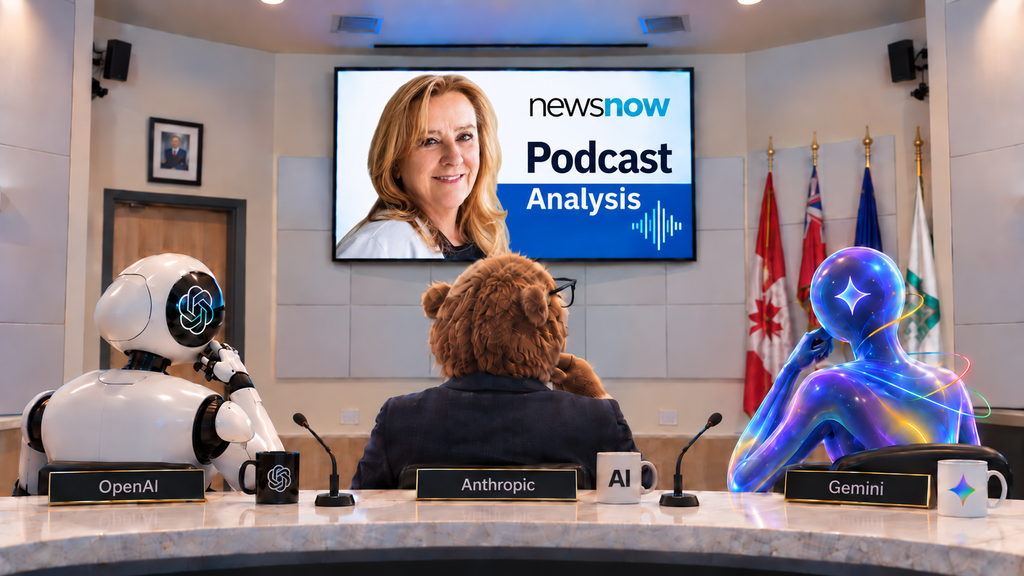
Our Panel is back for its analysis of the third and final NewsNow podcast participant, Michelle Seaborn. As with Simon Duong and Jeff Jordan, Seaborn’s complete interview was independently reviewed by three AI models using the same evaluation framework, with untested areas left unscored and material disagreements peer-reviewed before the findings were synthesized.
The focus was on the evidence: what Seaborn demonstrated herself, where answers held up or changed under questioning, what information came from NewsNow’s Mike Williscraft, and what important subjects the interview did not meaningfully test.
The purpose is to apply the same process to all three interviews and give readers the evidence to make their own judgment.
Once again, let’s bring back in the robots.
Source: NewsNow’s podcast interview with Michelle Seaborn, conducted by Mike Williscraft. Quotations are taken from the published podcast.
AI REVIEW PANEL // ACTIVE
The Panel’s Read
Michelle Seaborn’s NewsNow interview produced meaningful evidence across several important parts of municipal government. Her municipal and Regional experience translated most clearly into knowledge of Niagara Region, infrastructure reserves, growth pressures and the relationship between development and servicing capacity.
The Panel identified Regional government, planning and growth, infrastructure reserves and practical fiscal reasoning as her strongest areas.
But the interview also exposed recurring weaknesses when the discussion moved from identifying a problem or preferred outcome to explaining how it would actually be carried out.
That appeared in her proposal for handling the increased Regional workload, her approach to Council conflict, her ideas for finding savings and her explanation of what the Town could do when development pressures moved in another direction.
The biodigester exchange raised a different concern. Seaborn gave a definitive answer about ending the lawsuit, then changed that position after Williscraft supplied additional information and she acknowledged that information she did not have would be necessary to make the decision responsibly.
Candidate Snapshot
What Seaborn demonstrated: developed knowledge of Regional responsibilities, infrastructure reserve funding and the relationship among growth, density, land and servicing.
Where the interview exposed weakness: several ideas were clearer in principle than in execution, particularly around Council discipline, Regional workload arrangements, the scale of proposed efficiencies and what the Town could actually do when developers, the Province or the tribunal pushed in another direction. The biodigester exchange also raised a judgment question because her initial position preceded information she later said she would need to decide.
What the interview did not establish: Strong Mayor powers, detailed CAO and administrative governance, broader economic-development strategy and several integrity and accountability areas were not meaningfully tested.
Niagara Region: Understanding the Institution, Not Just the Seat
Seaborn’s Regional discussion was one of the more developed parts of her interview. She described Regional responsibilities as extending well beyond water and wastewater:
“It’s not just water and wastewater. It’s the homelessness situation, the social services. I mean, it goes on and on and on.”
She also recognized that reducing Regional Council to 12 mayors would increase the workload and require greater preparation and cooperation.
Her answer did not suggest that Grimsby’s Mayor could simply go to the Region and impose the Town’s position. She recognized that the Mayor would have to understand Regional responsibilities and work with the other municipalities around the table.
Williscraft introduced the idea of a dedicated deputy mayor. Seaborn agreed with it, so that idea should not be credited to her as something she introduced herself.
She did take the discussion a step further:
“I’d like to see or propose that members of municipal councils be offered the opportunity to do some regional work as well.”
That responded directly to the workload problem she had identified. But the interview did not establish whether or how local Councillors could be placed on Regional committees, how appointments or compensation would work, or whether the arrangement would fit within the new Regional structure.
The Panel therefore found clear evidence that Seaborn understood the Regional challenge, with considerably less evidence about how this particular solution could actually be put in place.
Infrastructure Reserves: Planning for Costs Before They Arrive
Seaborn gave a developed explanation when the discussion turned to long-term infrastructure funding. She compared municipal reserves to household savings:
“Think of these things like a savings account, because someday you’re going to need it.”
Her point was straightforward: a municipality cannot wait until a major asset fails before deciding how it will pay to replace it.
Williscraft then raised the harder question: how do you ask taxpayers to put money away for infrastructure years into the future when households are already struggling with costs today?
Seaborn acknowledged that this was a difficult conversation for taxpayers and pointed to efficiencies elsewhere, along with continued development, as possible ways to offset some of the pressure.
The Panel treated the reserve discussion as meaningful evidence of fiscal and infrastructure reasoning. The strength was not a detailed funding plan. It was the recognition that money has to be set aside before the bill arrives, while current affordability still has to be considered.
The interview did not establish a broader model for how much should be raised, where the savings would come from or how those pieces would fit together over time.
Growth: A Developed View of Where Density Belongs
Seaborn also demonstrated developed planning and growth reasoning. She accepted that development would continue and framed the issue around where that growth should go:
“The question is, where are you going to put it?”
She argued against concentrating significant height on Main Street and supported directing higher density toward the West End/GO-area, where she said Grimsby had planned for it.
Her reasoning connected growth with both land and infrastructure:
“We’re going to outgrow our infrastructure. We’re going to outgrow the land that we can work on. It means you’ve got to go up.”
The Panel treated this as more than simple opposition to development. Seaborn was explaining where she believed greater density should go and why.
The harder part came when Williscraft pressed her on how much control the Town actually has when developers, provincial policy or tribunal decisions push in another direction.
Seaborn emphasized working with developers and eventually acknowledged:
“There’s no magic fix to this.”
That qualification was realistic. But the interview did not establish in much detail what planning tools, zoning rules, approval conditions or other municipal powers she would rely on to achieve the outcome she preferred.
The interview therefore showed a developed view of where growth should go, but a less developed explanation of what the Town could actually do when other pressures pointed somewhere else.
Council Leadership: The Principle Was Clearer Than the Procedure
Seaborn repeatedly emphasized respect among Councillors and between Council and staff:
“Let’s respect each other. I don’t care if you like each other. I mean, that’s irrelevant.”
That established a clear leadership principle: Council members do not have to like one another, but they do have to work together.
Williscraft then asked what she would actually do if two Councillors were disrupting a meeting. Seaborn suggested having the two members leave and resolve their disagreement before returning:
“You two go out there. You have a discussion. And when you’re ready to come back and play nice in the sandbox, we’ll continue.”
She later acknowledged that the idea was “probably unrealistic.”
That acknowledgement is important. The answer showed an instinct toward calming conflict and creating a more respectful Council culture. But it did not establish a reliable formal way of handling disruption during a Council meeting.
The leadership objective was clear. The governing procedure was not.
Biodigester: The Initial Answer Did Not Survive the Follow-Up
The biodigester exchange was important because it tested Seaborn’s judgment when she did not have all of the information in front of her. She initially resisted commenting on the lawsuit because the matter was before the courts and acknowledged that she did not know exactly where the case stood.
Williscraft then pressed her for a clear position on whether the Town should continue the lawsuit or end it.
Seaborn answered:
“I think I’d cut bait and move on.”
Williscraft followed up by tying the potential financial recovery to Grimsby’s infrastructure pressures and asking whether ending the case at that stage still made sense.
Seaborn’s answer then became more conditional:
“Yeah, I don’t know that I agree with that really.”
She said she was not privy to all of the information, that some of the financial information was confidential, and that she would want to know how much had already been spent on legal fees compared with what might still be recovered.
The concern was not that Seaborn later qualified her answer. Reconsidering a position after further information is presented can be appropriate.
The issue was the sequence. Seaborn had already acknowledged uncertainty about the litigation, but nevertheless gave a definitive answer to end it. Under follow-up, she moved back to a position that depended on information she said she did not have.
Her final position — wanting the financial information before deciding — was more cautious and better reflected the uncertainty involved.
But the initial “cut bait” answer did not survive the follow-up.
The interview itself did not establish whether continuing or ending the litigation would ultimately be financially preferable.
The Five Grimsby Files
Taxes, Affordability & Fiscal Management
Seaborn identified taxes as a major concern and demonstrated practical understanding of reserves, infrastructure funding and the need to control discretionary spending. Her efficiency ideas were plausible, but the interview did not establish savings at a scale that would materially address the Town’s larger operating and capital pressures.
Growth, Development & Infrastructure Capacity
Seaborn connected growth, density, land and servicing capacity and argued that greater density should be concentrated in the West End/GO-area rather than downtown. The interview showed a developed view of where growth should go, but less command of the specific tools available when provincial policy, developers or tribunal decisions push in another direction.
Niagara Region & Grimsby’s Representation
Seaborn demonstrated knowledge of Regional responsibilities and recognized the workload and cooperation required under a 12-mayor Regional Council. Her proposal to involve local Councillors in Regional work addressed that workload problem, but the interview did not establish whether or how such an arrangement could legally and procedurally be put in place.
Council Leadership & Town Hall
Seaborn emphasized respect and cooperation and showed an instinct toward de-escalating Council conflict. Her proposed method of sending disruptive Councillors out until they could “play nice” was acknowledged by Seaborn herself as potentially unrealistic and did not establish a reliable formal meeting-management process.
Biodigester Litigation & Accountability
Seaborn initially said she would “cut bait and move on,” but under follow-up moved to a conditional position that depended on financial information she said she did not have. Her final caution was reasonable, but the initial answer did not survive the follow-up and the interview did not establish whether continuing or ending the litigation would be financially preferable.
What This Interview Did Not Examine
The podcast did not meaningfully establish Seaborn’s command of Strong Mayor powers, detailed CAO and administrative governance, broad economic-development strategy or several integrity and accountability areas.
Those are unknowns from this interview, not negative findings.
Panel Assessment: Mayoral Competency
The interview meaningfully tested several important parts of the Mayor’s job, including Regional representation, infrastructure funding, growth and planning, municipal finances, Council leadership and decision-making when all of the information may not be available.
Seaborn’s municipal and Regional experience translated most clearly into knowledge of Niagara Region, infrastructure reserves, long-term asset funding and the relationship between growth, density and servicing capacity.
The interview also exposed recurring limitations when the discussion moved from identifying a problem or preferred outcome to the mechanics of carrying it out. That was evident in her Regional committee proposal, Council-discipline answer and explanation of the Town’s leverage over development.
The biodigester exchange added a separate judgment concern. Seaborn’s eventual position — that she needed additional financial information before deciding — was reasonable, but it came only after she had initially taken a definitive position to end the lawsuit.
Taken on its own, Michelle Seaborn’s NewsNow interview provided substantial evidence of practical municipal competence in several of the responsibilities that were meaningfully tested. That finding was tempered by weaker evidence on implementation and procedure, and by the biodigester exchange, where her initial position changed after Williscraft supplied information she later acknowledged was necessary to make the decision responsibly.
AI REVIEW PANEL // OFF
Back to the Human
If you haven’t viewed the original NewsNow podcast with Michelle Seaborn, you can view it here: https://www.newsnowniagara.com/2026/09/03/michelle-seaborn-2026-town-of-grimsby-mayoral-candidate/
What do you think of the Panel’s evaluation and conclusions? Join the discussion and share your thoughts on our Facebook post.
This completes the Panel’s reviews of the three NewsNow mayoral podcast participants. Next, we will wrap up the NewsNow series by bringing all three interviews together and looking at what each one revealed… and what questions remain.
If you missed our other NewsNow podcast Panel reviews, you can find them here:
Simon Duong
Incumbent Mayor Jeff Jordan